

Globally, humanity now produces a staggering 450 million tonnes of plastic every year. From food and drink containers to cosmetics packaging, sewage pipes, window frames and polyester clothing, we use plastics in almost every area of life. And nearly one-quarter of them end up in the environment, where they very slowly degrade into microscopic pieces.
These microplastics — particles between one micrometre and five millimetres wide — have been found in the deepest parts of the oceans, at the top of the tallest mountains, at the sparsely populated poles and even inside the human body.
It is very difficult for living organisms, including humans, to avoid ingesting microplastics. If these microplastics cross the lining of the digestive tract to enter the bloodstream or other tissues, they will persist in the body. Until now, it has been difficult for researchers to accurately assess whether this is happening.
Our research team has developed a new technique to identify the location of microplastics within an organism without dissecting it. We tested it on earthworms and discovered that microplastics ranging in size from five to 53 micrometres do not readily cross the lining of the gut to enter other tissues in the worms.
The contamination problem
The question of whether microplastics simply pass through the digestive tract to be excreted, or cross the lining of the gut, has been challenging for researchers to answer. This is because the microplastic particles would need to be less than 83 micrometres in size — 10 times smaller than the head of a sewing pin.
Researchers have been forced to dissect the tissues out of organisms to determine whether such tiny particles may have traversed the lining of the digestive tract into other tissues. As microplastics are everywhere, it is very difficult to prevent contamination of the dissected samples with more microplastics, and so it is hard to accurately measure what was originally present.
Read more: How we turned plastic waste into vinegar: A sunlight-powered breakthrough
To avoid contending with contamination of tissue samples, our research team collaborated with the Canadian Light Source in Saskatoon to perform an extremely high resolution X-ray on earthworms using a technique called synchrotron-based microcomputed tomography.
Bright white particles
We chose to work with earthworms because they are essential for healthy soils and constantly move through and feed on soil where microplastics can accumulate. This makes them a useful species for studying how soil organisms interact with microplastic pollution.
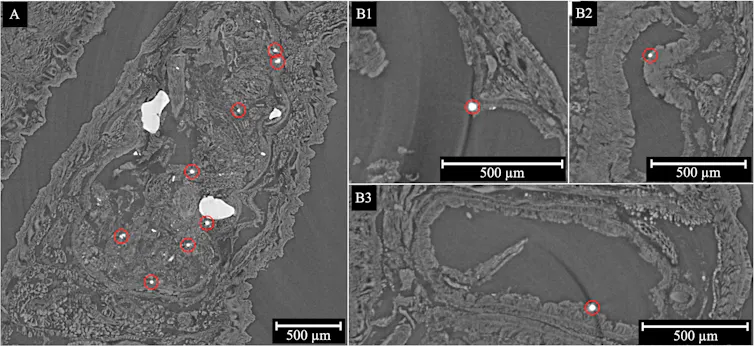
We fed the earthworms soil that contained either microparticles from five to 22 micrometres, or 45 to 53 micrometres, in size. These microplastics were coated with barium salts, which means that on an X-ray, they would show up as bright white particles in the earthworm.
A conventional X-ray would not provide the detail necessary to see the location of the microplastics in the earthworm. Microcomputed tomography allowed us to create a very detailed three-dimensional picture of the earthworm, in which the microplastics appear as bright particles against the backdrop of the darker tissues in the earthworm.
This allowed us to count the microplastics in the gut of the earthworm and determine whether any microplastics that the earthworm consumed had moved out of the gut into other tissues.
No microplastics outside the gut
We observed a total of 2,779 individual microplastics inside the digestive tracts of worms that were fed the contaminated soil. We found no microplastics at all outside the digestive tract of these worms.
This provides definitive evidence that microplastics ranging in size from five to 53 micrometres do not readily cross the lining of the gut to enter other tissues in the worm.
This is also the first time that synchrotron-based microcomputed tomography has been used to track the movement of microplastics within an organism.
The human digestive tract
Are the results of our study applicable to humans or other species?
While we need to be careful about extrapolating our research on earthworms to other species, our study does suggest we may need to give our digestive tract more credit for its ability to act as a barrier to components of our food that cannot be digested.
This study also underscores the importance of developing techniques that can identify the position of microplastics in the body of organisms without having to dissect them. These techniques, like synchrotron-based microcomputed tomography, provide a more conclusive result on how microplastics move in organisms.
This will help improve our risk assessment of microplastics to all of life, including humans.
